
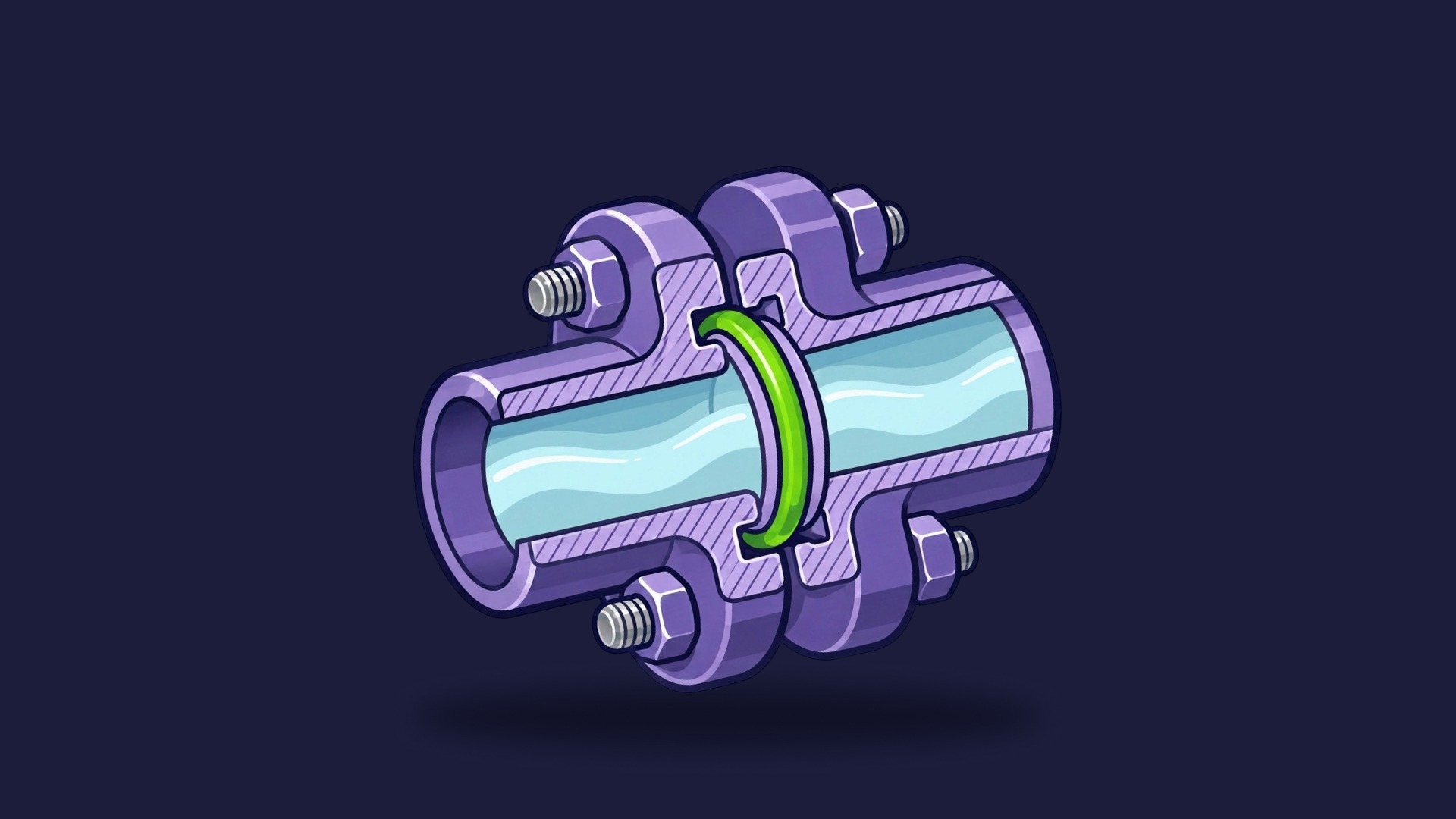
When engineers discuss FKM for coolants, the starting point often sounds simple: many automotive cooling systems use a mixture based on approximately 50% water and 50% glycol.
For an elastomeric seal, however, this description tells only part of the story.
Modern coolants also contain inhibitor packages designed to control corrosion, cavitation and deposits. Their chemistry can differ significantly between specifications and applications, from OAT and hybrid technologies used in passenger vehicles to NOAT formulations found in heavy-duty applications.
The result is a demanding environment in which temperature, time, coolant chemistry and mechanical compression act simultaneously on the seal.
And this changes the question from:
“Is FKM resistant to glycol?”
to:
“Will this FKM compound continue to seal after prolonged exposure to the actual coolant and operating conditions?”
FKM is a material family, not a single compound.
Different polymer architectures, cure systems, hardness levels and formulations can behave differently when exposed to hot aqueous fluids. This distinction becomes particularly important in cooling systems, where the material may need to combine:
For this reason, selecting an FKM for coolants should never rely only on a generic compatibility chart.
The complete duty cycle matters.
Among the available FKM technologies, GFLT-based compounds offer an interesting engineering balance for automotive cooling applications.
Their value lies not in maximising one isolated property, but in combining fluid resistance with improved low-temperature behaviour and suitable sealing performance over a broad operating range.
At Siliconiton, different GFLT and GFLT-related formulations are available within the FKM portfolio, allowing the compound to be selected according to the actual requirements of the application rather than relying on a single standard solution.
This is especially relevant when the same seal must work through cold starts, high operating temperatures and prolonged exposure to chemically demanding coolants.
Volume change is commonly considered when evaluating elastomer compatibility with a fluid.
It is important, but it is not sufficient.
A seal can show limited swelling and still lose its ability to maintain contact pressure.
For static sealing applications, compression set is therefore one of the most significant parameters to consider.
An O-ring works because it is compressed inside its groove. Over time, heat and chemical exposure can progressively reduce its ability to recover its original shape. As permanent deformation increases, the sealing force available at the interface can decrease.
This is why an effective FKM for coolants must be assessed not only for immersion resistance but also for its behaviour under compression.
Siliconiton's internal material database reflects this approach, including compression-set evaluations under several thermal conditions alongside fluid-resistance testing.
Cooling-system seals rarely experience one perfectly controlled condition.
During service, the elastomer may alternate between contact with hot coolant, thermal soak and exposure to hot air. In some components, nearby oils or other automotive fluids may also become part of the operating environment.
A formulation optimised only for coolant exposure is therefore not necessarily the best formulation for the entire application.
The objective is to achieve a balanced response between:
coolant resistance + compression set + hot-air ageing + low-temperature flexibility + mechanical-property retention.
This balance is where GFLT-based FKM becomes particularly valuable.
There is no universally “best” compound. The most appropriate solution depends on coolant specification, temperature range, exposure time, geometry, squeeze and the complete sealing environment.
The correct material-selection process should therefore begin with the actual application rather than with the polymer name.
For cooling-system components such as water pumps, thermostats, coolant lines, heat exchangers and thermal-management modules, the relevant question is not simply whether the elastomer is compatible with water and glycol.
The question is whether it can retain the properties required to maintain the seal throughout the expected service conditions.
This is the principle behind Siliconiton's approach to FKM for coolants: selecting and validating the compound around the complete operating envelope, with particular attention to the balance between fluid exposure, temperature and long-term sealing behaviour.
Because compatibility is only the first requirement.
The seal still has to seal.
